
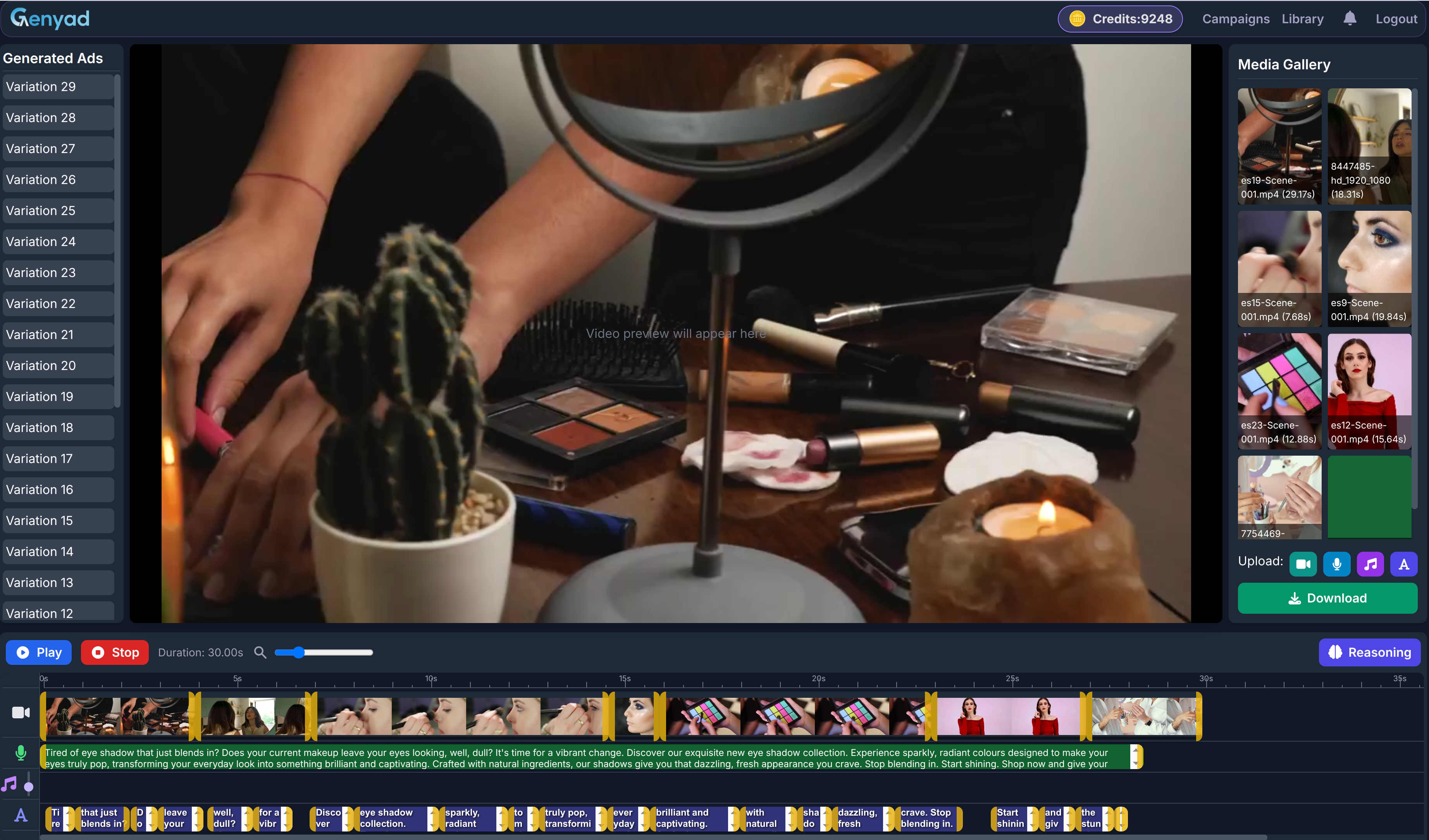
An ad agent for automation should take over the parts of ad production that are repetitive and rule-bound (transcribing footage, drafting scripts to a structure, choosing shots that match the script, recording voiceover, placing captions, exporting per platform, producing the next variation) and leave you the parts where taste and accountability live: the offer, the brand line you will not cross, the final approval, and reading the results. Teams that automate the first list and keep the second ship five to ten times more creative with the same headcount. Teams that try to automate the second list end up with a lot of ads nobody wanted to run.
This article is a practical split of the work. It is written from building Genyad, which is an agent of this type, and from watching what happened when teams handed it too little or too much.
The production chain, and who should own each link
| Step | Hand to the agent? | Why |
|---|---|---|
| Deciding the offer and the audience | No | This is the business. No agent knows your margin or your quarter. |
| Writing the brief | You, briefly | Two sentences of intent beats a page of instructions. See how to brief an AI ad generator. |
| Ingesting and understanding footage | Yes | Transcription, tagging what is shown and said, building a searchable library. Tedious and exact, ideal for automation. |
| Scripting to a structure (hook, story, CTA) | Yes, with review | Agents draft well from footage they understand. You approve the claim, not the commas. |
| Shot selection and sequencing | Yes | Matching clips to script lines by subject, tone and pacing is pattern work. |
| Voiceover | Yes | Emotion-aware TTS timed to the cut is now good enough that the decision is which voice, not whether. |
| Captions and text overlays | Yes | Placed from the script, in the campaign language, inside platform safe zones. |
| Format and length per platform | Yes | 9:16, 4:5, 1:1, and the cut that fits each. Pure rules. |
| Generating variations | Yes | The whole point. A new hook, angle, audience or language per prompt. |
| Brand guardrails | You, once | Words you never use, claims legal has cleared, visual rules. Set them, then let the agent apply them. |
| Final approval | You, every time | Ten seconds per ad. This is the step that keeps the agent honest. |
| Reading performance and deciding what to make next | You, with data | The agent can produce the next round; only you can say which direction it should go. |
What automation is actually buying you
The naive pitch is "save the editor's time." The real gain is different: it changes what is economically possible to test.
At an hour or more per finished variation, a two-person team can maintain maybe six to eight live ads and refresh a couple a week. Our fatigue benchmark suggests an active campaign wants eight to twenty in rotation with regular refreshes, and that most creative is worn out inside three weeks. The gap between those two numbers is why so many accounts are running tired ads. Once a variation costs a credit and a minute of review, the constraint moves from production to judgement, which is where you wanted it all along.
The second gain is consistency. Captions in the right safe zone every time, the same voice across a campaign, the disclaimer present in all 14 versions. Humans are bad at the fourteenth copy of anything.
Three ways teams get the split wrong
Handing over the brief. "Make me some ads for this product" produces generic ads. The agent needs to know who the ad is for and what you want them to do. That is two sentences. Write them.
Keeping the assembly. Some teams use an agent to write scripts and then rebuild the video by hand in an editor "to be safe." They get none of the volume and all of the review cost. If you do not trust the cut, fix the footage library or the brief; do not redo the work.
Skipping approval. The opposite failure. Auto-publishing straight to the ad account sounds efficient until a voiceover mispronounces the brand or a clip shows last season's packaging. Ten seconds of watching each ad is cheap insurance. Genyad exports for you to upload, partly for this reason.
A working weekly rhythm
Monday: read last week's numbers. Decide two things to try (a new angle, a new audience, a new language). Write a two-sentence brief for each.
Monday, later: generate eight to twelve variations across the two briefs. Review, edit the one or two that need it, export.
Tuesday: upload to Ads Manager, replace the weakest two live ads, launch the new ones in the same ad set so budget pools.
Rest of week: leave it alone. Frequency and CTR will tell you by next Monday what worked. Video ad metrics that predict fatigue lists what to watch.
Every four to six weeks: film a new batch of footage on a phone to keep the library fresh. The agent can only recombine what it has. Building a 90-day creative calendar without a bigger team is the longer version.
What it costs
Genyad's free plan covers five variations and one AI-generated clip with no card, which is enough to run the Monday routine once. After that a variation is one credit: €29 for 15, €99 for 65 with priority processing, and credits never expire. An AI-generated clip to fill a gap in your footage is 2 credits per second. Enterprise packs with 4K and a dedicated manager are priced on volume. The comparable manual cost is the editor hours, and Reshoot vs AI variation does that arithmetic.
Frequently asked questions
Can an ad agent automate posting and budget as well as production?
Some tools connect to ad accounts and will publish or adjust budgets. We deliberately stop at export. Production is where the hours went; budget decisions carry your money and belong with a person, or with the platform's own optimisation, which is already very good at it.
How is an ad agent for automation different from Zapier-style marketing automation?
Workflow automation moves data between tools when triggers fire. An ad agent does creative work: it writes, selects, voices and edits. You can put an agent inside a workflow (brief in, ads out), but the agent is the part making judgements about footage and copy.
Does automating ad creation make all the ads look the same?
It does if the library is thin or every brief is identical. Variety in the input footage and in the briefs is what produces variety in the output. Ten distinct clips and two different angles per week is enough to avoid it in our experience.