
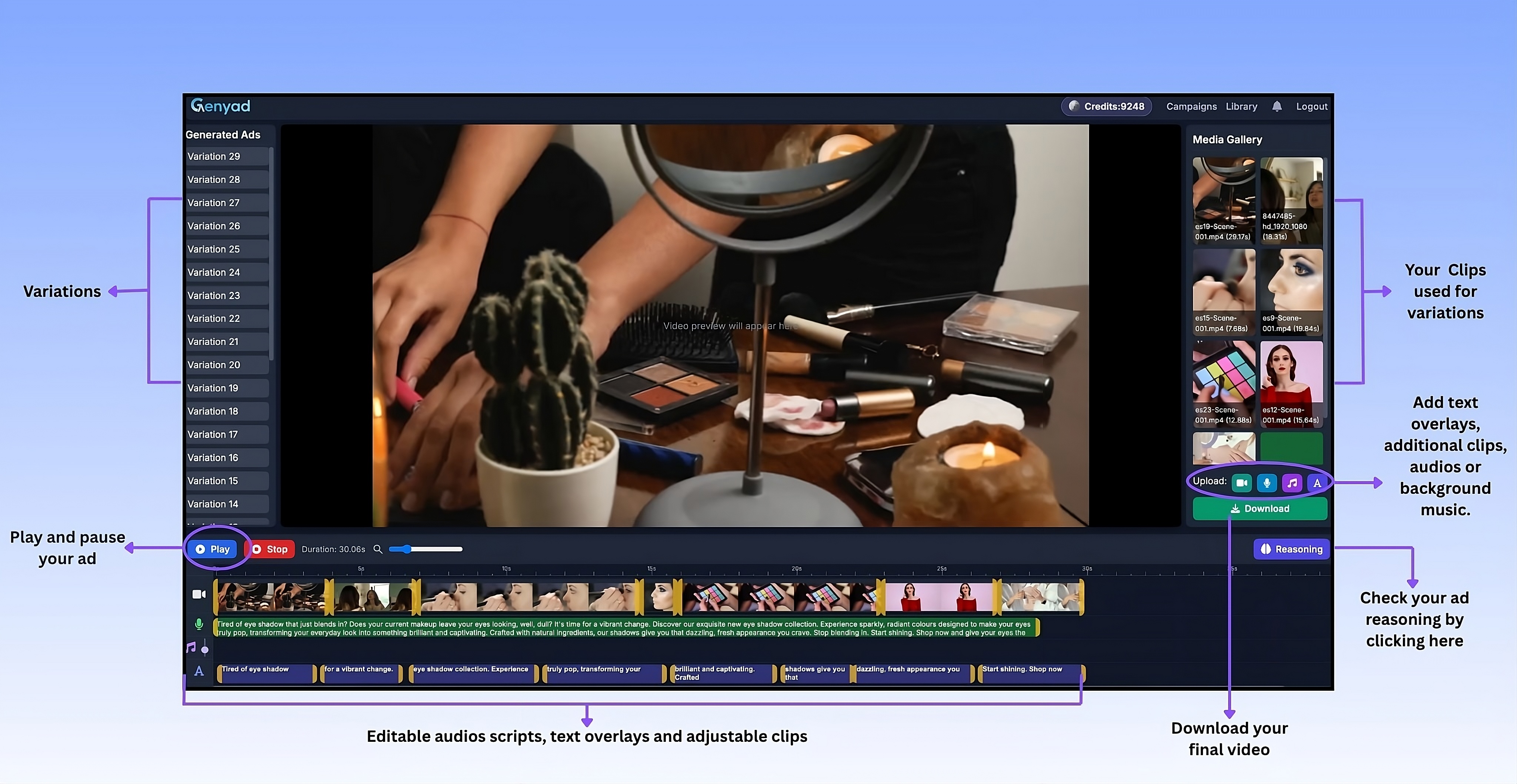
An AI agent for video ads is software that takes a goal ("a 15-second Reel for this product aimed at first-time buyers in Spain") and carries out the whole production chain to reach it: it writes the script, chooses the footage, records the voiceover, places the captions, cuts the edit and exports it in the right format, then does it again with different choices when you ask for variations. An AI video generator, by contrast, produces one clip from one prompt and leaves the assembling to you. The difference sounds academic until you are the person who has to ship twelve ads by Friday.
We build Genyad, which is an agent in this sense, so this article explains how we think about the category and what to look for if you are shopping for one.
Generator, copilot, agent
The three words get used interchangeably in marketing copy. They describe different amounts of work left on your desk.
| What you give it | What you get back | What is left for you | |
|---|---|---|---|
| AI video generator | A text or image prompt | One clip, usually 5 to 10 seconds | Script, structure, voiceover, captions, editing, formats |
| AI copilot / assistant | A timeline you are editing | Suggestions, auto-captions, a generated voice for your script | Every decision, in sequence |
| AI agent | A brief and a library of footage | Finished, publishable ads in the requested formats, plus alternatives | Review, small edits, approval |
A generator is a raw material supplier. A copilot is a very fast assistant editor who does not start anything on their own. An agent is closer to a junior production team you brief once.
What a video ad AI agent actually does, step by step
Using Genyad as the concrete example, because it is the one we can describe from the inside:
- Understands the footage. When you upload clips, the agent transcribes the speech, reads the on-screen context and tags what each clip shows, so later steps work with "close-up of the strap buckle, presenter says it is adjustable" rather than
IMG_4471.mov. - Writes the script from the brief and the footage. Structured as hook, product story, call to action. Because it knows what is in the clips, the copy refers to things the viewer will actually see. Per language and per platform length, it rewrites rather than translates.
- Selects and sequences visuals. Each clip is judged on subject, tone and pacing, assigned a role (the attention-grabbing open, the demo, the close) and arranged into an ad flow rather than a montage.
- Generates the voiceover. Emotion-aware narration in the campaign language, timed to the cut so the words land with the pictures.
- Edits and exports. Cuts timed to the voice, captions placed from the script, aspect ratio and length per platform. Everything remains editable: swap a clip, change the music, rewrite a line.
- Repeats with variation. Change the hook style, the audience or the language in the prompt and the agent produces a structurally different ad from the same library. This is where the agent model pays for itself, because step six costs a credit and a minute, not another afternoon.
An AI video generator is useful at step three when your library has a gap (Genyad includes text- and image-to-video for exactly that, at 2 credits per second). It does not replace the other five steps.
When an agent is the wrong tool
- You have no footage and do not want to film any. An agent working from a library has nothing to work with. Start with an avatar tool or, honestly, a phone.
- You need frame-exact brand templates. Regulated industries with mandated layouts are better served by template automation.
- You want to do the creative work yourself. Some editors like editing. A copilot inside your NLE keeps you in control and speeds you up; an agent takes the timeline away.
- Your variation is data, not ideas. The same ad for 300 store locations is a template job.
What to check before you trust one with a campaign
Ask the vendor, or test for yourself:
- Does it script from the footage, or write a generic script and hope the clips fit? Watch for copy that describes features never shown on screen.
- Is the voiceover timed to the edit, or laid over it? Listen for narration that drifts away from the pictures.
- Can you edit the output? A draft you cannot fix is a lottery ticket.
- How does it handle a second language? A translated script with the same cut is not localisation.
- What does one more variation cost in money and in your minutes? That number decides whether you will actually run twelve ads or three.
The economics, briefly
Producing a finished ad by hand, including captions and two formats, runs 45 minutes to several hours of a competent editor's time. On Genyad the first five variations are free, then one credit each (€29 buys 15, €99 buys 65, and credits do not expire). The cost that matters is the review minute per variation, because that is what limits how many you can ship a week. Reshoot vs AI variation has the fuller comparison.
Related reading
- Ad variations explained
- An ad agent for automation: what to hand off and what to keep
- How to brief an AI ad generator so it nails the first draft
Frequently asked questions
Is an AI agent for video ads the same as an AI avatar tool?
No. Avatar tools (Arcads, Creatify's avatars, TikTok Symphony) generate a person delivering a script. An agent for video ads assembles complete ads from footage and a brief. They overlap on voiceover and captions and are often used together: avatars for testimonial-style ads, an agent for product and demo ads.
Can a video ad AI agent publish directly to Meta or TikTok?
Genyad exports platform-ready files you upload to Ads Manager or TikTok Ads, with performance analytics available in the platform. Direct publishing exists in some competing tools; we have prioritised the production side because that is where teams told us the bottleneck was.
How much footage does the agent need?
Enough distinct moments to give it choices. Ten to fifteen short clips covering the product in use, the problem, a close-up and a reaction is a good minimum. A single long walkthrough works but produces less variety.